Showing posts with label Food. Show all posts

"Salt Sugar Fat: How the Food Giants Hooked Us " by Michael Moss

By sulthan on Wednesday, March 6, 2013

http://atrandom.com/files/2013/02/Salt-Sugar-Fat_3D-COVER_nospine.jpg
       
   
      From a Pulitzer Prize–winning investigative reporter at The New York Times comes the explosive story of the rise of the processed food industry and its link to the emerging obesity epidemic. Michael Moss reveals how companies use salt, sugar, and fat to addict us and, more important, how we can fight back.
 

http://www.amazon.com/
http://edition.cnn.com/


Selengkapnya

Infographic: The Mountains of Salt in Processed Food

By sulthan on Tuesday, July 3, 2012


salt infographic

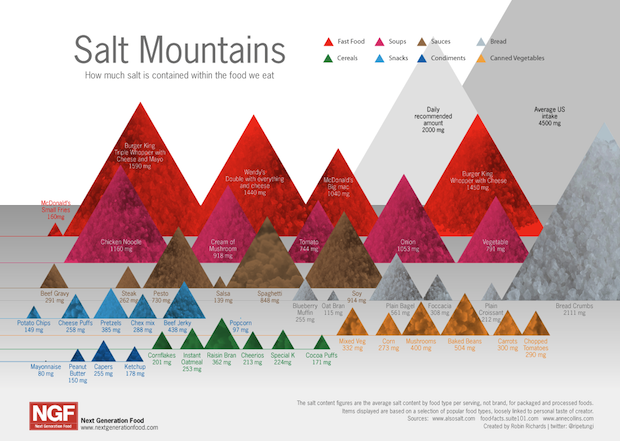
You already know that salt intake is highly correlated with high blood pressure and heart disease. And you probably have a vague sense that processed foods contain a lot of salt. But the specifics are truly terrifying, as this graphic by Next Generation Food shows.
It's not exactly the most legible graph--I mean, triangles aren't exactly a case study in information clarity. But the point comes through. Check out, for example, that fact that a single Burger King Whopper with cheese has 75% of your recommended daily salt intake; and the fact that Americans eat 250% of their recommended daily allotment:

salt infographic

Obviously, eating less meat and more vegetables is an easy way to reducing salt consumption. And the benefits could be vast: An important recent study by the American Heart Association found that just reducing salt intake by a teaspoon could save 200,000 lives every single year.
Their advice? Basically you must avoid as much as possible or even better  If it comes in prepackaged and it doesn't rot, don't eat it.
Selengkapnya

Ingenious Label Design Ensures Food Safety

By sulthan on Sunday, April 29, 2012

http://cdn.psfk.com/wp-content/uploads/2009/09/Screen-shot-2010-05-03-at-10.20.12-PM-525x449.png?fedaf9
     Japanese design agency TO-GENKYO has designed an innovative hourglass shaped label for packaged meat which uses a special ink that changes color as ammonia is released inside the package. As the meat ages, it releases increasing amounts of the substance, obscuring the barcode at the bottom. Customers can quickly see if the meat is going bad – and when the barcode becomes completely covered, it can’t be scanned.

http://cdn.psfk.com/wp-content/uploads/2009/09/Screen-shot-2010-05-03-at-10.20.05-PM-525x364.png?fedaf9


  via PSFK: http://www.psfk.com/2009/09/ingenious-label-design-ensures-food-safety.html#ixzz1tQMqhh0
Selengkapnya

Photos of food and their sugar-cube equivalent

By sulthan on Wednesday, February 22, 2012


See more photos of food and their sugar-cube equivalent http://www.sugarstacks.com/
Enhanced by Zemanta
Selengkapnya

Yes You Can Eat Healthy on a Budget

By sulthan on Tuesday, November 22, 2011

When you’re on a tight budget, the thought of preparing tasty, healthy meals on a regular basis can seem daunting. Not only is it easy to get sucked in by grocery merchandising tricks, but it’s also normal for most of us to fall into a mealtime rut, eating the same foods over and over. But you’re in control of your kitchen—and if you cook smart, you can enjoy the first-class meals you deserve.
 
Before you even walk out the door, sit down, write out a list, and stick to it. Shop once a week, and cut out coupons from the paper (skip those for processed foods that are expensive, even with the coupon!)

Money-saving fundamentals:
  • Don’t go shopping on an empty stomach! Make sure you shop after a meal, or after a light snack to help resist temptation.
  • Shop the perimeter (outside) of the store first. That’s where all of the healthier choices usually are; you’ll avoid all the more processed, costly items.
  • Look for sales on fresh fruits and vegetables — stores get a bargain sometimes, and pass that savings on to you
  • Choose a large bag of fruit (like apples or pears), instead of the single, large fruits priced per pound.
Buy generic:Generic brands can provide a great savings when shopping and are often labeled as the store’s brands. The nutritional value of the food is the same, whether it’s canned, frozen, or bagged foods.

 Skip organic:
There are some benefits to buying organic foods, but the nutritional content is equivalent is both organic and “conventional” (non-organic) foods. You don’t necessarily get better nutritional content with organic foods, although some people prefer the taste of organic foods. Buy conventional items to save money. Try to buy locally grown foods, when in season, for added savings.

Chose large-sized drinks:
Avoid buying soda, juice drinks, and sports drinks. Limit 100 percent juice purchases — buy the whole fruit instead. Stick with water — from the tap (unless there is a health concern to limit your local area’s tap water). Skip the bottled water. If you do purchase 100 percent juice or soda, choose reduced-sugar or sugar-free, and a large size (half gallon is common) for better savings. The single serving packages are costly — you’re paying for the container.

Make your own snacks: There’s been in explosion in single-serving snacks from chips to cookies to cereal. Many are available 100-calorie portions. While portion control is a great thing, you don’t need to pay for it. Buy some snack-size re-sealable plastic bags, and make your own single-serving packets.
Cut down on the number of snacks you buy. Make a family decision — choose one treat from the chip and cookie categories, and buy a large bag of each for the week. No need for multiple bags of snacks. Most processed snack foods are expensive and typically provide little if any nutritional punch.

Go frozen: The winter does pose a challenge when balancing nutrient intake and cost. Bananas, apples, and pears are all good choices. For other produce, go to the frozen food cases. Frozen (or canned packed in water or 100 percent juice) fruits and vegetables are good choices. Skip ones packed in sauces. And look for low-salt options.Try freezing your own berries during the summer, when prices are low.

Avoid the exotic:
Go with “standard” colors of vegetables and fruits — green peppers, for example, are not as exotic as yellow, red, or orange, but are a fraction of the cost. Stick with whole fruits and vegetables, and cut them up yourself. Don’t buy the pre-cut stuff. And any leftovers can be put in a plastic bag and frozen for later use.

Buy sale items: Look for sales, but only if you know what to do with the food! Items like meat, and poultry can be divided and frozen for later use  for a variety of meals. Shop the warehouses, if you can split the packages with a friend — particularly for perishable foods. That five-pound bag of vegetables doesn’t look very big in a warehouse store, but can hardly fit in many refrigerators.

What about restaurant eating?
Instead of choosing a “value meal” at a fast-food restaurant, downsize to a “kid’s meal” — better portion control, and an option of bottled water (instead of soda) and veggies instead of fries if you choose. Too tired too cook? Buy a rotisserie chicken at the store, and add the side dishes, drinks, and dessert at home.

Dr. Fernstrom’s Bottom Line: With a little pre-planning, you can be a healthier eater on a budget. You can enjoy greater variety, avoid deprivation, and gain a shopping strategy that is both easy on your waistline and your wallet.


Madelyn Fernstrom, Ph.D., CNS,is the founder and director of the University of Pittsburgh Medical Center’s Weight Management Center. An associate professor of psychiatry, epidemiology, and surgery at the University of Pittsburgh School of Medicine, Fernstrom is also a board-certified nutrition specialist from theAmerican College of Nutrition.

PLEASE NOTE: The information in this column should not be construed as providing specific medical advice, but rather to offer readers information to better understand their lives and health. It is not intended to provide an alternative to professional treatment or to replace the services of a physician.

Useful Links:

Healthy Budget-Friendly Recipes http://www.eatingwell.com/recipes_menus/collections/healthy_budget_friendly_recipes

16 Ways to Eat Healthy While Keeping it Cheap

20 Simple Ways to Eat Healthy on a Budget


Selengkapnya

Urbanization and Cardiovascular Disease: Raising Heart-Healthy Children in Today’s Cities

By sulthan on Thursday, September 29, 2011

WORLD HEART FEDERATION CALLS FOR URGENT ACTION TO PROTECT CHILDREN’S HEART HEALTH IN WORLD’S MOST POPULOUS CITIES

New S.P.A.C.E strategy to address threat to the cardiovascular health of the world’s urban children

Geneva, 29 September 2011 – On World Heart Day, the World Heart Federation calls for a new approach to make cities heart healthier for the children who live in them. The call to action follows research commissioned by them which shows that increasing urbanization threatens the current and future heart health of children.


The research results are presented in a new report entitled, Urbanization and Cardiovascular Disease: Raising Heart-Healthy Children in Today’s Cities. The report summary – made available today – shows how urban life in low- and middle-income countries – often imposes limitations on the ways in which children live, and restricts opportunities for heart-healthy behaviours. In large cities across the globe, urban living actually facilitates unhealthy behaviour in children, including: physical inactivity, eating unhealthy foods, and even tobacco use by children as young as two. Crowded city living environments can also spread diseases such as rheumatic fever, which if left untreated, can cause rheumatic heart disease.

The report notes that children are particularly at risk of the negative health effects of city life, since they are most dependent on and affected by their living environment. Since urbanization is continuing to occur rapidly worldwide, urgent action is needed to prevent an “epidemic” of cardiovascular disease (CVD) including heart attacks and stroke.

Although urbanization can be positive, bringing with it great opportunities, inherent to city-life are practical and logistical obstructions to heart-healthy behaviour for children. Lack of recreational space or unsafe environments may cause children to be inactive, or poor economic circumstance may force parents trying to feed hungry children to purchase cheap but unhealthy food high in fat, salts and sugars,” explains Professor Sidney C. Smith Jr, MD, President of the World Heart Federation.


To support policymakers, city planners, and other adults concerned with making cities more heart healthy, the World Heart Federation has devised the S.P.A.C.E strategy, which incorporates five critical elements:

•    Stakeholder collaboration – To bring together all those who have an impact on children’s lives and health, including family, neighbours, teachers, religious and community leaders. Local and national governments need to ensure that city planning includes all these stakeholders.

•    Planning cities – So that they incorporate healthy choices in the natural, built, social and economic environment. As cities grow and land comes under ever more pressure, it is essential that the interests of children and their health are taken into account in the planning process. This includes providing space for outdoor recreation and exercise, limiting the presence of unhealthy food choices, and promoting smoke-free environments.

•    Access to healthcare – The intensive population of urban areas can make the provision of healthcare easier. However, inequities persist and prevent poor people from getting the healthcare they need. Investment in paediatric healthcare will greatly improve CVD outcomes within cities.

•    Child-focused dialogue – All city dwellers face similar risks to their future heart health, but children’s needs are very specific and need to be addressed separately from those of adults. It is important that approaches to improving heart health should include elements that are aimed specifically at children.

•    Evaluation – More information and research is needed to fully understand the impact that cities have on children’s heart health. Every city provides different risks and opportunities. Therefore, each city needs to carry out its own evaluation to establish the risks that exist and what can be done to mitigate them.

We recognize that the S.P.A.C.E strategy may not be fully applicable or affordable for all nations currently experiencing the rapid urbanization of their populations. But it is hoped that the report presents a range of options to policymakers that are looking for initiatives to make a difference to CVD health outcomes,” said Johanna Ralston, Chief Executive Officer at the World Heart Federation. 

Creating environments that facilitate healthy behaviour can help children to build a heart-healthy future. By introducing the new S.P.A.C.E strategy, planners, government officials and other adults who have an impact on children’s lives can help to make cities as healthy as possible for future generations.


Enhanced by Zemanta
Selengkapnya

Blueberries faked in cereals, muffins, bagels and other food products

By sulthan on Friday, August 26, 2011

The blueberries found in blueberry bagels, cereals, breads and muffins are REAL blueberries right? Wrong! Award-winning investigative journalist Mike Adams, the Health Ranger, exposes the deceptive chemical ingredients and dishonest marketing of "blueberry" products from big-name food and cereal companies. The blueberries, it turns out, are made from artificial colors, hydrogenated oils and liquid sugars. See more episodes at www.FoodInvestigations.com 


Blueberries have long been touted as a superfood, high in antioxidants, vitamin C, and manganese. And unlike other superfoods like acai berries, bee pollen, and wakame seaweed, blueberries are accessible and attractive, so they're an easy sell to anyone skeptical of health food.
So this reputation could be why blueberries are in so many packaged foods, from muffin mixes to salad dressings. They appear to add nutrition and deliciousness that might otherwise be lacking. Nevermind that actual, fresh blueberries are only in season about 2 to 3 months out of the year -- the blueberry harvest goes on all year at the grocery store.

But have you actually read the labels on those supposedly blueberry-filled products?
Some of them, like Target Blueberry Bagels and General Mills Total Pomegranate Blueberry Cereal, might be fooling consumers into thinking the food has something it doesn't. While manufacturers state they're still within the U.S.'s admittedly loose labeling laws, many of those blueberry-promoting products are made without genuine blueberries.
The Consumer Wellness Center recently produced a Food Investigations video that looked at the actual blueberry content of several widely available packaged foods. This expose shows how Kellogs, General Mills, Betty Crocker, and other brands advertise plump, whole blueberries in their cereals and mixes, but deliever dextrose, corn flour, partially hydrogenated soybean oil, sugar, citric acid, artificial flavor, and food colorings Blue #1 and Red #40 instead.
Selengkapnya

Breastfeeding . Why Human milk is irreplaceable?

By sulthan on Monday, August 22, 2011

World Breastfeeding Week  1–7 August 2011

      World Breastfeeding Week is celebrated every year from 1 to 7 August in more than 120 countries to encourage breastfeeding and improve the health of babies around the world. It commemorates the Innocenti Declaration made by WHO and UNICEF policy-makers in August 1990 to protect, promote and support breastfeeding.

      Breastfeeding is the best way to provide newborns with the nutrients they need. WHO recommends exclusive breastfeeding until a baby is six months old, and continued breastfeeding with the addition of nutritious complementary foods for up to two years or beyond.

Introduction to Breastfeeding

          Breast milk is thought to be the best form of nutrition for neonates and infants. The properties of human milk facilitate the transition of life from in utero to ex utero. This dynamic fluid provides a diverse array of bioactive substances to the developing infant during critical periods of brain, immune, and gut development. The clinician must be familiar with how the mammary gland produces human milk and how its properties nourish and protect the breastfeeding infant.

             Clinicians play a crucial role in a mother's decision to breastfeed and can facilitate her success in lactation. Although a mother may not be aware of the evidence indicating that breast milk contributes to her baby's short-term and long-term well-being, she has developed certain attitudes and cultural beliefs about breastfeeding. The issue of bonding between mother and newborn may be a strong factor; however, stronger cultural or societal barriers may result in the decision to formula feed. Such issues must be understood for successful counseling. The mother makes her decision regarding breastfeeding prior to delivery in more than 90% of cases; therefore, her choice of infant nutrition should be discussed starting in the second trimester and continue as part of an ongoing dialogue during each obstetric visit.

          Breastfeeding or bottle feeding your newborn baby is a personal decision. If you choose to breastfeed, it will be helpful if you are in a supportive environment and have resources to assist you with questions you may have or problems that may develop. 
  • Consider attending a series of La Leche League meetings or reading La Leche League's book on breastfeeding (The Womanly Art of Breastfeeding) before the birth of your baby.

  • Ask other breastfeeding mothers for advice.

  • A supportive network including other like-minded mothers helps with the commitments of this style of feeding.

  • If you are undecided at birth time, consider a one-month trial. It is easy to go from breastfeeding to bottle-feeding.

  • The first month of breastfeeding is the most difficult, so if you get through that period, the rest will be easier.
Campaign Video : "Breastfeeding: First food for champions!"  


    Comparison with Formula-Feeding

    • The ideal food for human infants is human milk. Human milk contains all the right ingredients—protein, carbohydrates, fats, vitamins, minerals, and water—in just the right balance. No formula can make that claim. Infant formula manufacturers attempt to artificially duplicate human milk. Formula feeding is a practice that is relatively recent—about 60 years—compared to the beginning of humankind (not to mention all other mammals) relying on breast milk.

    • Formula does not contain the disease-fighting factors or the digestive enzymes that breast milk has. The nutrients in formula are more difficult for a baby to digest and absorb than the nutrients in human milk, requiring the baby to handle excess waste. Some formulas may have a less than optimal composition by containing too much salt and/or not enough cholesterol, fats, lactose, zinc, and iron, among other nutrients.
    • Some infants fed a cow's milk-based formula may develop allergies to the proteins in the cow's milk. Infants who are allergic to cow's milk often are also allergic to "hypoallergenic" (non-allergy-causing) soy formulas.

    • During the early months, a formula-fed baby may develop signs of allergy to or intolerance of a particular formula. These signs may include the following:

      • Bouts of crying after feeding

      • Vomiting after most feedings

      • Persistent diarrhea or constipation

      • Colic with a distended tense painful abdomen after feeding

      • Generally irritable behavior

      • A red, rough sandpaper-like rash especially around the face or anus or in both places

      • Frequent colds and ear infections

      • Red itchy rash especially in the folds of the elbow and knee joints

    • These signs, or the baby's preference, may lead you through a series of different formulas, often each more expensive than the last.

    • Formula-fed infants may be exposed to a variety of environmental substances used during the preparation of the formula or carried as a minor contaminate from which breastfed infants are protected. 
    Benefits of Breastfeeding
    • With rare exceptions, breast milk is the preferred feeding for infants and confers unique benefits.

      Breastfed babies (for at least 6 months) may be at reduced risk for many acute and chronic diseases, including gastrointestinal tract infection (like diarrhea), lower respiratory tract infections (like a cold), urinary tract infections, otitis media (ear infections), and allergic reactions (like atopic dermatitis and asthma).
      The effect of breastfeeding in protecting against infection is well established. Infants who were fully breastfed for 6 months or more seem to have higher mental development when compared with infants who were never breastfed. Some studies show that the effects of breastfeeding may carry over and also protect young children and adolescents from becoming overweight.

    • Milk has biologic specificity—meaning that every species of animal who breastfeeds their babies makes a milk that is unique for the young of that species.

    • The amounts of nutrients change to match your baby's rapidly changing needs.

    • The fat content increases during a feeding so that the baby gets the right amount of fat. Human milk contains the right kinds of fats along with an enzyme (lipase) that helps digest the fat.

    • Cholesterol is high in human milk, lower in cow's milk, and very low in formulas. Cholesterol promotes brain growth and provides basic components of hormones, vitamin D, and intestinal bile.

    • Milk (cow's, formula, and human) contains two main proteins: whey and casein. Whey is easier for humans to digest and is found in higher concentrations in human milk.

    • Around 6 months of age, the baby's intestines mature and become less open to proteins that may harm the body as allergenic proteins (allergens). Giving only human milk until the intestines mature is the best way to keep potentially allergy-causing proteins out of baby's blood.

    • Human milk includes helpful proteins not naturally found in milk made by cows or companies.

    • Human milk is fresh and contains more lactose (sugar) than cow's milk. Formulas add sucrose or glucose (other types of sugars).

    • Vitamins and minerals have a higher bioavailability in human milk. In other words, the body uses most of what is in the milk. There is very little waste.

    • The germs in the baby's environment, to which the mother has been exposed, cause the mother to produce antibodies to that germ, which are passed on to the breastfeeding infant.

    • Breastfeeding relaxes mother and baby.

    • Women who breastfeed have a lower incidence of breast cancer.

    • Breastfed babies tend to be healthier.

    • Breastfeeding is less expensive.
    Prepare for Breastfeeding

    • There is really no physical preparation that is necessary for breastfeeding. Education about the benefits and practice of breastfeeding is the best preparation. Contrary to some popular beliefs, it is not necessary to "toughen up" or prepare the nipples in advance for breastfeeding. Some techniques of stimulating the nipples may actually be harmful.

    • Sometimes women prepare for breastfeeding by exposing the nipples to air for a certain amount of time each day; while this has not been shown to be medically useful, it is likely not harmful either.

    • Take a breastfeeding class. Your hospital may offer breastfeeding classes as part of the childbirth class. These classes can put you in touch with a lactation specialist who may later be your personal breastfeeding consultant.

    • Join your local La Leche League or other breastfeeding support group. Call (800) LA LECHE to find your local leader.

    • Talk with supportive friends who encourage your feeding choices.

    • Learn proper positioning and latch-on techniques.
    First Feedings

    • Within a few minutes after birth, most babies can be introduced to breastfeeding. Relax. Most babies take a few licks, sucks, and pause. Sucking in frequent bursts and pauses is the usual pattern for the first few hours and sometimes even the first few days. The first milk the mother produces, colostrum, is the best food.

    • Breastfeeding also helps the uterus contract, which helps stop uterine bleeding.

    • Try to room-in with your baby. When you see your baby begin to open its eyes, look around, and put his or her fist into his or her mouth, then it is time to offer your breast.

      • Try to make the nurses understand that you wish to breastfeed and that your baby should not be given sugar water or formula without you and your health care provider being aware and consenting.

      • You may need to have the nurses actually put a sign on your baby's bed restricting bottle-feeding.

    • Try latching the baby on at the first signs of hunger. Do not wait until the baby cries, or you will teach the baby to cry to get your attention. The baby will get upset more quickly the longer you take to respond.

      Conclusion :
     
              Human milk, in addition to its numerous nutrients that make it an ideal food source for the growing term infant, is a bioactive fluid that evolves from colostrum to mature milk as the infant matures. This bioactive fluid contains numerous factors and live cells that, in concert, promote the growth and well-being of the breastfeeding infant. Oliver Wendell Holmes said it best when he stated, "A pair of substantial mammary glands has the advantage over the two hemispheres of the most learned professor's brain, in the art of compounding a nutritious fluid for infants." With the ever-expanding knowledge resulting from current research, commercial formula clearly cannot replicate all of the valuable properties that are inherent in human milk.

    Source:
    world_breastfeeding_week
    breastfeeding/article
    http://emedicine.medscape.com/article/1835675-overview      
     http://www.cdph.ca.gov/HealthInfo/healthyliving/childfamily/Pages/CommonQuestions.aspx
    http://www.cdph.ca.gov/HealthInfo/healthyliving/childfamily/Page  /EducationalMaterialsforBreastfeedingFamilies.aspx
    http://www.webmd.com/parenting/baby/baby-food-nutrition-9/default.htm
    http://www.happybabyfood.com/health-nutrition/47/210-happybaby-nutrition-guide
     Age by age guide to feeding your baby  http://www.babycenter.com/0_age-by-age-guide-to-feeding-your-baby_1400680.bc
    Enhanced by Zemanta
    Selengkapnya

    Infographic -> 9 Foods That Last Forever

    By sulthan on Thursday, April 7, 2011

    Selengkapnya