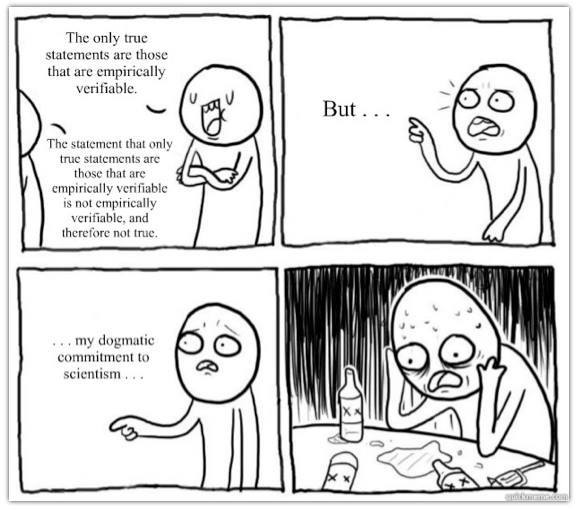
MODERATOR: Welcome to another episode of Clash of Worldviews. Tonight we’re fortunate to have with us in the studio Fred Gulpa, self-described alt right transhumanist; Rich Goldfarb, a fiery young Jewish conservative debater; Adam Garnett, noted liberal secular humanist; and Heather Fogarty, hypermodern skeptic and gadfly. Welcome to all of you and to our viewers joining us from around the world. Tonight the topic is postmodern conservatism. What does it mean to be a conservative in the twenty-first century, under advanced technoscientific, postindustrial conditions? Who would like to start us off?
RICH: That’s a preposterous question and you’re an imbecile for asking it. Your hair is all messed up and I’m appalled by your cheap aftershave, which I’m aghast to say I can smell all the way from over here. So you must be a closet liberal, which is unfortunate because all liberals are evil.
MODERATOR: Uh, oh…kay? That wasn’t quite the response I was looking for. I understood that you’re a professional debater, Rich. Have you learned about ad hominem attacks?—not to mention red herrings, since I’m just the moderator here.

RICH: You see that’s just like a liberal. Run from your liberalism all you like, but it’s a disgrace.
You want to know what conservatism means today. I’ll tell you: it means standing up for divine or natural rights against tyrannies like the liberal state that holds a gun to your head to push corrupt liberal values down your throat and to collect ill-gotten taxes to grow its Mafioso hold over the population. The liberal government is an incompetent bureaucracy that can’t do anything right except shake down its citizens, disrupt the free flow of market competition, and expand the cushy public sector for the pack of liberal cronies. Conservatism means respecting the traditions that connect us with what’s right in the world so that we can oppose what’s evil. And liberalism is evil. Liberalism boils down to kleptocratic communism: the liberal state wants to redistribute money that was earned in market transactions, which means the government steals from the rich to give to the poor—like Robin Hood, except that instead of a hero, the government is evil. Stealing is wrong. And like cancer, the liberal state needs runaway growth in its tyrannical powers to protect unnatural liberal morality, including silly rights for women’s equality with men, for the killing of babies, for politically-correct recognition of absurdities such as the wholesomeness of homosexuality, and for government boondoggles like its nonsolutions to the overhyped problem of global warming.
ADAM: I mean: wow. Just, wow. It’s safe to say there must have been a hundred strawmen in that screed.
RICH: Everything I just said is obviously correct. You’re an execrable monster and a charlatan and a demonic insect for suggesting otherwise.
HEATHER: Uh, Rich, I think someone neglected to inform you that Clash of Worldviews isn’t like the infotainment newshour shows or campus debates you’re used to having, in which the goal is to pwn your opponent with vile hate speech and cheap zingers. We’ll actually expect some arguments here and won’t be impressed by schoolyard tactics.
RICH: Thanks for the tip. But everything I said is still obviously correct. There is no counterargument for liberals, since all liberals ever do is call conservatives bad names. Liberals are the ones with no arguments, and that’s because liberals are—
ADAM: —evil. That’s what you were going to say, right? Yeah, that shtick’s going to get old real fast. You’re starting to sound like Ben Shapiro.
RICH: I’m waiting for the rebuttal.
Theocracy, Natural Rights, and the Tyranny of Liberalism

ADAM: Alright. First of all, you said a lot more about liberalism than about conservatism, even though liberalism isn’t our topic. But fine, maybe we can arrive at the nature of conservatism indirectly, by focusing for a while on its opposite.
So just for starters, your slide from social democracy, or the so-called liberal establishment, to communism or tyranny is a grotesque oversimplification. In a democratic country with a capitalistic economy like the United States, the government needs certain powers to protect the social fabric and thus to prevent an outbreak of chaos, as in what’s called a failed state. The selfish impulses that capitalism nurtures are utterly amoral. For example, enterprising businessmen in early American history had no compunction against selling slaves; likewise, even today there’s a thriving business of human trafficking of sex slaves. Responsible governments collect taxes not just to protect private property or to defend against foreign enemies, but to preserve the public welfare, which means upholding its culture’s ideals. Slavery is against both Christian and Enlightenment values, but as long as there’s a supply of and demand for slaves, capitalism itself isn’t going to end slavery. Thus, the government needs to step in as a bulwark against capitalistic greed.
I mean, there are a hundred other grotesqueries in your rant, but let’s leave it there for a minute. Tell us, then, how are all liberal governments communistic or tyrannical?
RICH: A social democracy is communistic and tyrannical because it’s the same principles that are being violated, regardless of the differences in the degree of evil. Stalin killed millions of his citizens and Obama didn’t lower himself to quite that level, but both idolized the state and prized the bureaucracy over the welfare of the majority. Obama didn’t care about the average citizen when he bailed out the big banks or when he subsidized irrelevant green energy companies. He cared only about his donors and his elitist comrades. Instead of letting all Americans face up to their responsibilities as free individuals and trusting in their ingenuity and entrepreneurialism, Obama propped up failing institutions, offsetting the costs onto consumers in the form of higher taxes or inflation. Obama weakened the economy by rewarding risky lenders, borrowers, and investors, setting us up for the next bust in the economic cycle.
HEATHER: No, Obama tried (and failed) to de-rig the economy which nature had rigged under Clinton’s and Bush’s years of deregulation. Obama protected the majority from a second Great Depression that could have occurred, had the big banks been allowed to see their greed through to the bitter end. It was nature in the form of the selfishness and short-sightedness of the home-buyers and bankers—which are essential to unregulated capitalism—that left Obama with the remnants of that ticking time bomb of an economy. And why is nature so volatile and indifferent to the majority’s welfare? Why in the wild do predators prey on the herd? Because there are no rights in nature, nor is there any god in control.

How ironic for you to demonize neoliberal politicians like Obama, who didn’t take even a rhetorical stand for a public option in the healthcare debate and who thus never represented progressives, when the real villains in the economy are obviously your plutocratic heroes who don’t deserve their wealth because they perpetrate frauds like the housing market, corrupting or circumventing regulators and market analysts like those at Moody’s and putting the whole country at risk. If anything, redistributing much of their ill-gotten gains does the plutocrats a favour, by lessening the temptations which tend to turn the wealthy into rampaging psychopaths with god complexes.
You say regulators cheat the economy by picking winners and losers and preventing entrepreneurs from saving the day, as would allegedly happen in the more natural or godly course of events in which market competition is allowed to unfold. But the same counterfactual point can be turned against you. Plutocrats like the Koch brothers and the Wall Street bankers and the big donors to political campaigns and the rest of the top one percent of the American population that has such a disproportionate influence over politicians who write the tax code and the loopholes in the banking laws—those titans of industry and of financial fraud likewise prevent the little guys from getting ahead, by being instrumental in the decline of American unions, for example.
So your economic picture is warped. You depict a meritocratic market being tampered with by arrogant government officials, but that description is incomplete, at best. There’s an additional source of manipulation in the economy, namely the machination of the richest one percent. Indeed, the government’s interventions are needed to counter those of the lords of the private sector. It’s not as if the economic playing field would be leveled in a perfectly deregulated marketplace, were the government almost nowhere to be found. On the contrary, monopolies and oligopolies would form, wages would be lowered as unions are crushed, demagogues would bamboozle the consumers, and prices would reflect perceptions that have been distorted by masterful market manipulations that ignore the long-term costs of that rapacity, to the world’s detriment.
ADAM: I’d add that there is, of course, an enormous difference between communism or tyranny and social democracy: the latter is more self-governing than the former. In a democracy like the United States, the majority have a say over the identity of their political representatives. Granted, in practice there are numerous flaws, including gerrymandering, the Electoral College and so on, but in a dictatorship there isn’t even a theoretical possibility of removing the tyrant until he dies from his debaucheries. So it’s merely a bizarre rhetorical trick to call a liberal state tyrannical.

FRED: I’d like to weigh in on the merits of democracy. The United States is indeed democratic and that’s why it’s doomed. Capitalism and personal freedom flourish in places like Hong Kong, Singapore and Dubai, and those populations don’t have to worry about their country being looted by elected politicians and bureaucrats who aren’t invested in the people’s welfare, because they’re hired guns at war with opposing parties and so they’re inclined to salt the earth after their transient time in office, to sabotage their opponent’s administration. The attention span of elected authorities is narrow and so democracies are inefficient at addressing long-term issues; the infrastructure therefore tends to decline, for example. Moreover, democracies are prone to being attacked by demagogues who exploit the free-flow of information in the media, filling the culture with disinformation, which burdens the public with a blinkered view of reality, causing it to elect politicians who are, at best, only superficially suitable for high office. What keeps the overall standard of living from declining, at least in parts of a liberal democracy, is the competition for profit in the market, which leads to innovation and to a decrease in the price of goods over time.

ADAM: Some of those criticisms apply much more to so-called conservative politicians than to liberal ones. Democrats believe in good government, so to protect their brand, as it were, their incentive is to project at least the appearance that a democratic government can work, whereas Republicans trust more in the market and so they have reason to enlist foxes to guard the hen house and to act like a wrecking crew while in office, as Thomas Frank pointed out in his book by that name.
But let’s not get bogged down in an amateurish either-or debate. No one except for Captain Overstatement here is saying that one side is purely evil and the other purely good. Democracy has its problems and so does capitalism. We’re not here to debate their comparative merits so much as to explore what it means to be a late modern conservative. Isn’t that oxymoronic, to live in a new world but to hold on to an old one? How is conservatism even possible now? Aren’t today’s so-called conservatives nothing of the kind? I mean, what are they conserving when they say a postindustrial marketplace should be allowed to operate without governmental intervention?
MODERATOR: It’s a fair question. Rich, do you want to address that? What makes you a conservative?
RICH:…
HEATHER: I think he’s sulking.
RICH: No, I’m just disgusted that I have to sit near useful idiots who make excuses for the evil government’s theft of private property and for its bullying of hard-working wealthy Americans.

HEATHER: Yeah, the top one percent of power elites who’ve gotten all the increase in American income growth over the last several decades sure do need a tax break. Watch me shed a tear for the billionaires.
Wait a minute. I think I see the key to all this: it’s Judaism. Rich’s zealotry must stem from his Jewish upbringing. He already said conservatives defend the only source of rightness in the world, which is God’s Word or natural normality. So God commanded that we not steal or be jealous of others’ private property. Therefore, a tax-and-spend liberal government that coddles a lazy underclass is sinful. Is that about right, Rich?
RICH: Of course liberalism is sinful and not just wrong on the economic technicalities.
HEATHER: Well, that’s because nothing is really right or wrong on those technicalities. Economics is a pseudoscience and economists use fancy math like squid ink, to hide the counterfactuality of their models.
RICH: Whatever! The government has no right to steal money from the rich and to give it to the poor.
ADAM: No right, because God said so?
RICH: That’s what I believe as an Orthodox Jew.
ADAM: Ah, but that’s an embarrassment, isn’t it? It’s one thing to speak with an aggressive, commanding tone, talking a mile a minute and piling up the personal attacks as though your opponent didn’t have a leg to stand on. It’s another to admit that something as quaint and silly as theism is at the bottom of all your politics. You have the nerve to speak of liberal bureaucrats as acting like mafia bosses, but there’s a reason they call Vito Corleone the godfather. Indeed, has there been a more tribal, tyrannical, Trump-like man-baby of a god than Yahweh as portrayed in the Jewish scriptures? Arguably not.
RICH: That blasphemous remark is an abominable hate crime against my religious identity, and my lawyers will be in touch. In any case, I don’t appeal to Judaism to publicly support my social philosophy.
HEATHER: Well, what then do you conserve as a conservative, if not for God’s Word? It must be natural law. Is stealing supposed to be unnatural? What a joke that would be. Have you ever seen a mouse sneak into a kitchen and eat food from the cupboards? Or how about the cuckoo bird that lays its eggs in other birds’ nests to avoid having to feed its oversized babies? How about a beta wolf that mates with the alpha’s squeeze on the sly?
RICH: Obviously animals don’t have freedom or private property, so they can’t be guilty of crimes like murder or theft.

HEATHER: That’s right. And so humans are rational persons who set up unnatural societies befitting our anomalous skillsets. Do you see where that takes you? It means that as far as we can manage, humans aren’t beholden to so-called natural laws. Our rights flow from the artificial laws we conceive of, not from instincts produced by natural selection. So why should any human society appeal to natural rights when those are suitable, at best, only for animals?
If we work hard and earn a pile of money, you say we have a natural right not to have that property be stolen by anyone, including the government. In so far as that right is merely natural and not justified by anything like a political constitution or philosophical declaration of rights, the right to private property rests purely on power. Might makes right, money equals power, so the right to keep your earnings amounts to the warning that thieves had better watch out, because the aggrieved party may still have power enough to take vengeance. Or else the power itself will corrupt, and so the thief should think twice before trying to acquire power in such an underhanded way.
But if that’s the primitive basis of conservative social policy, it can easily be parodied with the sort of Just So stories you find in evolutionary biology. Maybe men are stronger than women, so men have a natural right to rape them. Maybe some nations are stronger than others and so the weak should serve the strong as slaves. Where does that anti-progress end? Why not just annihilate human civilization with nuclear bomb blasts and get it over with? Why did our primordial, protohuman forebears struggle to achieve self-awareness in the first place if their “conservative” descendants were just going to spit on those miraculous acts of transcendence and whine that we should stop acting like civilized persons and be more primitive? What a joke!
Technolibertarianism and the Instrument of Unchained Capitalism

FRED: All this talk of miracles and transcendence coming from an atheist? That’s the joke that amuses me. You’re getting hung up on Rich’s brand of adolescent self-righteousness, but you’re missing where the action is in conservative circles these days.
It’s a question of means and ends. The viable conservative’s ultimate goal is the transhumanist one of becoming godlike due to a superabundance of technoscientific power. A crucial instrument for achieving that goal is capitalistic competition, which drives businesses to employ the top researchers and engineers, thus incentivizing the innovative production of sellable goods. Many of the products need to satisfy our chief demand, which is to become godlike—now that the fictional deities are known to be dead, as culture critics from Nietzsche to Yuval Harari have recognized. Unchained capitalism that proceeds at a breakneck pace towards achieving that ultimate end entails social hierarchy. In that analogy, liberal qualms are the chains or the brakes that only delay our destiny as a species, and the result of liberal sentimentality is the imposition of artificial social equalities which hinder the great work of capitalism.
That, then, is the crux of the matter for late modern conservatives. It’s not about defending ancient moral codes as being good in themselves, because some god allegedly commanded that women should submit to men or that homosexuals should be stoned or that humans ought to have dominion over the sea and the earth. That’s paleoconservatism, and it’s an embarrassment that has no chance of withstanding science-centered skepticism. What we need is neoconservatism that makes peace with the strongest elements of modernity, such as technoscience and capitalism, while abandoning the weaker ones such as democracy, rationalism, and maudlin liberal morality.

Neoconservativism began in the US in the 1960s, as a backlash against the pacifist opposition to the Vietnam War. Rather than being theocrats, those neoconservatives were the often Jewish and therefore comparatively atheistic cold warriors who advocated a hawkish foreign policy in the name of spreading democracy in the furtherance of capitalist interests. Most of which was thoroughly wrongheaded. Those neoconservatives seem to have gotten caught up in Leo Strauss’s double game; they bought into their noble lies that were meant only for the unphilosophical masses. What are now called the neoreactionary conservatives—including Steve Bannon, who’s the resident philosopher king of the White House—reject democracy precisely because it doesn’t sit well with capitalism. Democracy works only when the masses who indirectly rule are equally in possession of the traits that would make them worthy to look after their national affairs. But the brutal truth of capitalism is that it creates a hundred losers for every winner, and the losers naturally stagnate, making them unworthy of a vote.

Capitalism, though, is the greatest force for good on Earth, because it’s the fuel for technoscientific progress, which is our only hope of salvation. Read your Moldbug and your Nick Land: capitalism is the answer not just in economics but in politics. Instead of stealth oligarchy, such as we have now in the US, we should be open about the greater efficiencies made possible by living under the promise of profit and the threat of literal bankruptcy in all walks of life. Instead of a nation we need corporations; instead of a government we need a board of directors and corporate officers such as CEOs. Power relations should be formalized and made transparent so that politics can be run efficiently as a business. And again, what makes this conservative is that we should embrace the resulting inequalities and hierarchies as steps we need to take on our way to the posthuman future.
ADAM: Again, wow. What an odious worldview you have there. No wonder your fellow deplorables hide under a rock in their mommy’s basement, playing video games, trolling chat forums, and emerging only at night to offend women in clubs with their “game.”
FRED: And I thought Clash of Worldviews was about arguments, not personal attacks. You see, this is the liberal’s sentimentality I was talking about. It’s like the feminist’s double standard: she wants equality but she also wants to be treated like a lady. She can’t have both, but she expects men to look the other way and to play along, because it’s supposed to be rude to shatter the illusions of the weak-willed folk who need them. So instead of rubbing the feminist’s nose in the ugly truth, that she’s been duped by the liberal culture, we neoreactionaries run our game on these women, and with every sexual conquest we prove that the value of social equality is based on a lie.
 Likewise, Adam thinks he can stand on the mere offensiveness of the harsh truths I’ve just told. He thinks he can fall back on his effeminate protests against a manly worldview that could be responsible for “offending” women in night clubs. Horror of horrors! Meanwhile, his liberal rationalism is a form of worshipping human nature, which causes him to hide from the holocaust we members of developed countries are perpetrating on most other animal species. Is he man enough to hunt for his meat? No, that’s now a conservative’s pastime. So he’s either a hypocrite or a vegetarian, but if he’s the latter, he must be a radical rather than a secular humanist, since the humanist always puts human pleasure first. Either way, he’s a hypocrite.
ADAM: Just because I’m offended by your bestial notions doesn’t make me less of a man than you.
FRED: Then why not try specifying what’s wrong with neoreactionary conservatism?
ADAM: Again, where to start! I agree that capitalism by itself generates and preserves social inequalities. So who is supposed to be cheering for this posthuman end point, the wealthy who will likely be the only ones to reap the benefits or the masses who will be thereby enslaved? The whole thing is incoherent.
FRED: Is it? Most people only want to worship a god, while some want to be gods. The former are consumers who should be duped by capitalists for the greater good, instead of by liberals for the democratic state which retards progress. Those who want to be gods are the psychopaths who tend to elevate themselves to high positions in their dominance hierarchies. So there’s no such incoherence, and once again we’re left with the worries of a feminized beta male.
HEATHER: Ugh! Enough with the penis-measuring contest. I’m not interested in that macho nonsense. Let’s get down to philosophical business here and discover where the truth lies.
I thank Fred for his presentation of what indeed looks like a late modern form of conservatism, one that marries Silicon Valley technolibertarianism with a Nietzschean or Lovecraftian reaction against the Enlightenment. We’re meant to embrace the empirical knowledge and technology that have made possible modern economic growth, while spitting on democracy and the liberal ethos that have provided for the civic religion that’s placated the masses who might otherwise have been disgusted with that growth. As you suggested, Fred, we’ve been swimming in noble lies about reason, freedom, and the American Way. The Enlightenment was itself a reaction against the Christian theocrats’ dogmas, which held back scientific progress. And now the neoreactionaries want that progress without the noble lies. That strikes me as a dangerous game to play.
FRED: Are you saying you’re a friend of the noble lie? I thought you were a cynic and a skeptic, eternally vigilant against any sign of self-deceit. Surely you haven’t fallen for the liberal’s work of megafiction. And if you say you and some minority are enlightened while the masses should be left in ignorance, there you have the makings of an inequality and a social hierarchy.
HEATHER: Not exactly, since for me the truly enlightened individuals should be mere gadflies, not godlike psychopathic dominators.
FRED: Fine, but that still means you’re not exactly a liberal; you’re not an egalitarian warrior for social justice, sworn to rectify every offense taken by a spoiled millennial.

HEATHER: If you’re asking whether social equality is my highest value, I’d say no it’s not. But that doesn’t mean I’d rejoice at the prospect of any old hierarchy, such as the sort that’s left in the wake of heartless capitalism. You say economic inequality is a necessary evil of the unregulated, selfish hunt of profit, since while that kind of capitalism devolves into a free-for-all for sociopaths and their cronies who naturally double-cross the know-nothing consumers, greed and cruel struggles for profit are instrumental to some transhuman future. The liberal imposition of social equality, then, is supposed to be an act of feminine cowardice, an intrusive restraint on progress.
But is transhumanism meant to be just a substitute myth to replace faith in a pre-existing deity? Or are we supposed to take that extreme merger with technology seriously as a physical probability?
FRED: It’s both. Transhumanism serves as a religion that isn’t wildly irresponsible in light of our current state of knowledge and power. Yes, it’s speculative to think we’ll decode the brain and be able to recreate consciousness in a computer. Yes, it’s speculative to think nanoengineering and cloning and all the rest will solve all our problems. But unlike the premodern religions, these science fictional scenarios aren’t mere escapist fantasies.
Moreover, even should transhumanism turn out to be a crock and we’ll never be more godlike than we are now, running with capitalism and disposing of milquetoast liberalism would still be the noble course. We have a chance to serve in a grand enterprise that may succeed or fail, or else to languish in the limbo foisted by neoliberal centrism. Neoliberal triangulation only balances the left and the right so that the country goes nowhere: you enable capitalism and the welfare state, but only so far so that either side ends up holding the other back. As Adam Curtis explains in his documentaries, the public loses faith in politicians because it looks like they’re technocratic system managers, cloaking their nihilism in serious-sounding pragmatic rhetoric.
HEATHER: Well, I agree with some of that, but I couldn’t sign on to a transhumanist religion.
FRED: Why? Because you only want to criticize but never to join a movement, because you want to look at everything from above, with ironic detachment, so you never have to risk feeling disappointed if the plan doesn’t work out? You don’t want to give yourself to anything greater than yourself, because deep down you’re an individualist and a narcissist to boot.
HEATHER: I am an individualist. As I said, the evolution of self-awareness, language and reason which make our autonomy possible are virtual miracles in the universe, meaning that they’re intriguing anomalies. So any mass movement which denigrates our potential to enlighten ourselves and to seek honour in a flawed world is an unsavoury con, in my judgment.
FRED: But transhumanism celebrates personal liberty! The goal is to use technoscience to deify us so we can do whatever we want.
HEATHER: Unfortunately, that myth is hampered by its literary debt to ancient theism. Gods go crazy because they become corrupted by their power and isolation. That’s the history of monotheism and of the popes and caliphs and kings who ruled in their god’s name. Human gods would be just as disastrous as the model gods they worshipped. And anyway, most people wouldn’t enjoy the technologies in question, since the tools and enhancements would be hoarded by the power elites who are the least in favour of competition, by the way, since they seek to establish monopolies or oligopolies at every opportunity.
ADAM: I’d like to step in here and remind everyone that liberalism is the progressive force, not conservatism. Equal rights for minorities are signs of progress, whereas racism and misogyny, slavery and patriarchy have always prevented the freedom of thought which is the cornerstone of scientific and technological development.
FRED: In previous empires, perhaps such traditions did blind the masses to the benefits of secularism, but that’s only because they were upheld by theistic fairy tales. The point of neoreactionary conservatism is that we can have the inequalities without the dubious myths. Instead, we have natural relations between means and end. Sacrifice in the capitalistic struggle for selfish advantage so that the techno gods might be born!
ADAM: But which inequalities would you excuse? Are you saying whites should rule over blacks, men should dominate women, and heterosexuals should persecute homosexuals?
FRED: Any hierarchy which is a byproduct of unvarnished capitalism is worth it if that social order improves the chance of our realizing the next stage of our evolution—because human nature as it is now won’t cut it.
ADAM: But let’s just take one of these vaunted inequalities as an example. You say egalitarianism has held back progress towards realizing the transhumanist dream. For centuries, patriarchy kept women out of the marketplace, but after the rise of Western women in the last century, productivity increased tremendously because women could finally educate themselves and apply their professional talents in competition with men. So that’s a case of social equality benefitting capitalism, contrary to what a neoreactionary would have predicted.

FRED: Again, only those equalities that are grossly artificial, which have to be sustained by enormous governmental effort and which impede the cutthroat competition in the marketplace that spurs growth should be eliminated. As for working women, much of their equality with men is illusory. Many have lower incomes than men in the same line of work, because women need to take off more time to raise their children. In any case, as long as women are competing with men with no unfair advantage from government aid, the market will sort us all into a dominance hierarchy. Only when such a hierarchy arises do you know you have a working capitalist economy, rather than a stale socialist one with centralized power in the hands of know-it-all bureaucrats. A conservative prizes the inequality as a sign that great struggles for power are taking place, with the byproducts of winners and losers. And we should hope that the end of that struggle is a glorious, posthuman form of life.
HEATHER: The vast economic inequality in the US, between the richest one percent and everyone else isn’t the result of any such noble struggle. The postindustrial economy is based on financialization, which is the rise of a class of con artists, bearing pseudoscientific economic models, who don’t make anything but just prey on host countries with massive frauds. So no, I’m afraid not all social inequalities are signs of hard work or progress. Some competitions are rigged to go nowhere or even to self-destruct. Like Rich, the Fox News memes of the culture war have blinded you to the fact that power can be concentrated not just by a government but by a cadre of plutocrats.
RICH: Well, I’m intrigued by Fred’s new form of conservatism. Where it errs, in my view, is its discounting of the benefits of a modest welfare state. So-called unregulated or unvarnished conservatism would descend into anarchy and would indeed self-destruct. Some taxed protections of the losers in the marketplace are needed to maintain public confidence that their country isn’t a cesspool that deserves to be reduced to ashes by an almighty God.
FRED: Alas, there’s no such God, but a religion inspired by science fiction can provide new justifications for a doubling down on capitalism, as I’ve explained.
RICH: The American Founders embraced Judeo-Christian morality as the basis of their Declaration of Independence. Some form of welfare state is needed to protect our God-given or natural rights, and taxes are needed to preserve the infrastructure that enforces those protections. By contrast, purely private interests would dictate that the losers deserve their failure and should be left to rot. No one should want to be part of such an amoral, heartless wasteland as the one you envision.

FRED: There are no such inherent rights because there’s no such Creator. We have to work hard to create the divine, posthuman beings that would manifestly have the absolute right to rule. And I hate to burst your bubble, but postindustrial behaviours, as opposed to the noble lies we tell ourselves, are already amoral and heartless. Again, we’re devastating the ecosystem and we support dictators or otherwise illiberal governments abroad to protect the young wage slaves who mass-produce the junk we so greedily consume. Yet we don’t hesitate to identify with America, with the land of the free and the home of the brave, because we buy into the myths. All I’m saying is we could use new myths, ones that wouldn’t bolster such shocking self-deception.
MODERATOR: I’m afraid we’re out of time, guests. Perhaps the upshot is that conservatism under postindustrial conditions will have to look very different from its traditional, theocratic form if it’s to avoid being largely ridiculous. At any rate, I’d like to thank you all for this stimulating exchange of ideas. Stay tuned for mind-numbing platitudes and distractions meant to keep you in the dark until you’re dead and buried.