Showing posts with label Necronomicon. Show all posts

Eldritch Revelations: The Mystery of Consciousness and the Fear of Death

By sulthan on Saturday, March 18, 2017

[In his published monograph, Eldritch Revelations (One, Two, Three), the psychiatrist of the infamous Jurgen Schulz wrote that only short fragments of Schulz’s philosophical journal survived his escape from Borsa Castle. But after the psychiatrist’s mysterious death shortly after publication, longer fragments were discovered in the psychiatrist’s office, locked in a drawer. The publisher of ER herewith appends these longer fragments as they’re made available by the translator, beginning with this passage on the problem of consciousness.] 

***

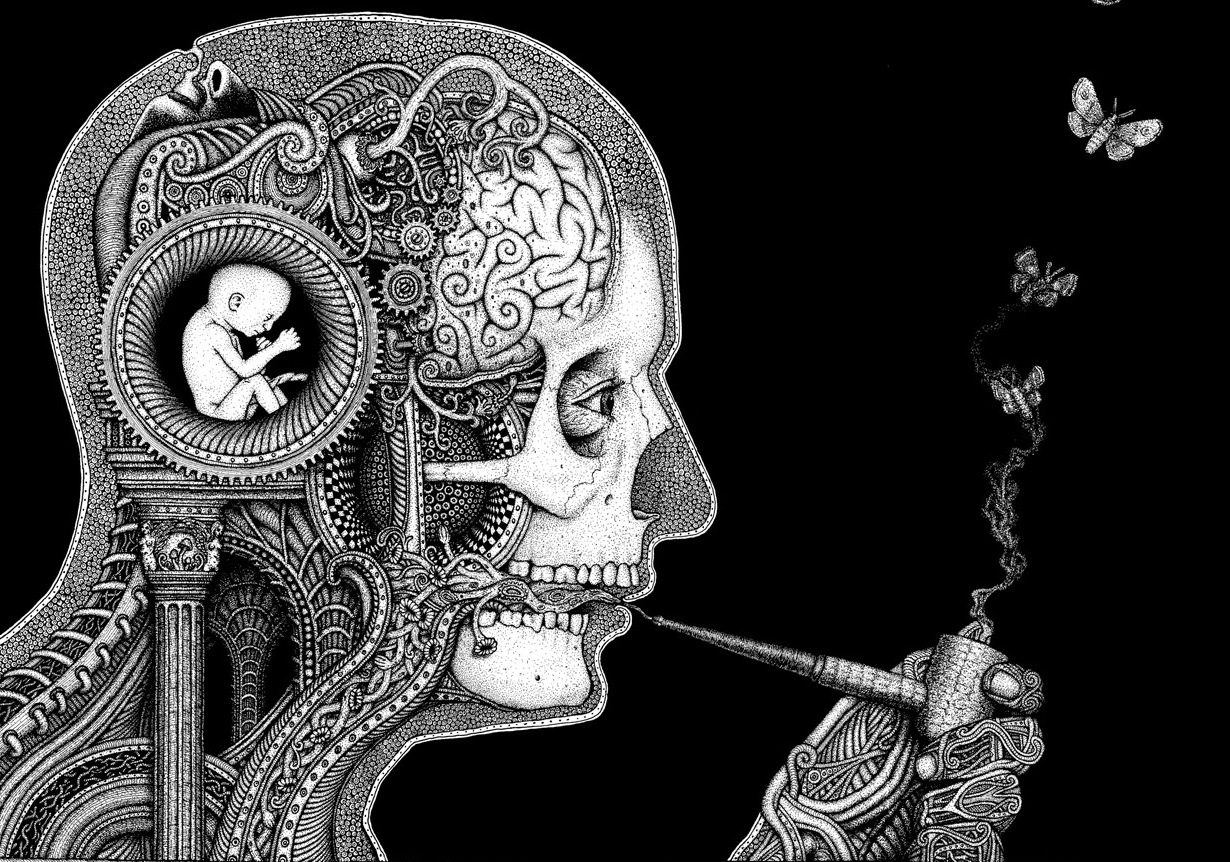
Perhaps the oldest fiction is that there are two worlds instead of one, the timeless, invisible, spiritual heaven that directs the material realm in which things come and go. And our unique dignity as enlightened beings is supposed to lie in our having a foothold in both worlds. Our consciousness belongs to the unseen utopia, to the hidden source of truth and beauty, while our body is plainly a physical object that emerges, evolves, and decays along with everything else in nature. But as physiologists learned how the body operates, the mystery deepened as to how ethereal consciousness, which used to be known as the spirit, could arise from matter. Our inner domain which seems like a sliver of supernature is full of mental contents, including tastes, smells, emotions, and thoughts, which are utterly unlike the stuff in which our body, including our brain consists. When you taste an exquisite dessert, you wouldn’t thereby be tempted to eat the neurons that are associated with that sensation, since the two tastes would be altogether different. There’s a philosophical mystery of consciousness, then, because there’s a mental blockage in our attempt to conceive of how a physical thing could have an interior point of view, a private world of meaningful mental states.

Less well known is that this problem of the apparent duality of matter and mind has two equivalent formulations, one of which proves more enlightening than the other. The common formulation is the evolutionary one, according to which we have difficulty explaining how mind emerges from matter. Notice, though, that the explanatory relationship can be reversed, in which case we might wonder how mind can be dissolved into matter. This latter formulation is just an abstract statement of the problem of death, as opposed to the question of how consciousness is created in the first place. How material compounds can cohere in such a way that they take on a conscious viewpoint which allows the material aggregate to act knowingly and creatively in what is mostly a lifeless void is one mystery. An equivalent mystery begins with the datum of consciousness and proceeds to the question of how consciousness fades away with the body’s eventual demise.

The second way of putting the problem shows why both mysteries appear to have no solution. The heart of the conundrum isn’t intellectual, but emotional. It’s not that we lack the brainpower to conceive of how mind can be merged with a material body; rather, we can’t bear to pursue the issue forthrightly, because we’re innately horrified by the inevitability of our personal death. Indeed, we’d prefer to live forever, but are confronted by the impermanence of all natural things. Thus, we’re blocked from understanding how a material thing can be conscious, because we’re disgusted by our future in which we’ll be no more, as our body deteriorates and expires. Were we presented with a theory that specifies the mechanics of how consciousness interacts with or inheres in matter, we would refuse to accept the implications as long as we still feared death.

That fear is in turn a consequence of our love of life. Every cell of our being drives us to live more and better, which is why the contemplation of death is morbid and taboo. To ponder what your death will be like is to betray the genetic compulsion and hormones and cultural conditioning that establish the norm of living with blinders to certain dark realities. Biologically, we perceive only that fraction of the universe which is useful to our survival, although science has entered us into the infamous Faustian bargain in which we dare to see further than is recommended to maintain our sanity. Death is despicable because we’re naturally driven to prolong our life at all costs, and this instinct is at least a precondition of the mind-body problem. Of course, the theoretical problem is agonized over by livingcreatures, by clever animals that figured out not just how to be self-aware, but that the self will apparently be extinguished at the end of a process of material dying. The certainty of death is apparent only to highly intelligent creatures that have learned to wrestle with complexities and abstractions that are unknown to lesser organisms. Nevertheless, the will to survive is universal in the animal kingdom and thus the terror of death persists even in the philosopher.

True, we can be depressive and suicidal, but even should we relinquish the zest for life and embark upon a plot to kill ourselves, we can experience only the act of dying, never the end of death. As long as we live, we live in bodies that evolved to protect themselves, to preserve and to transmit their genetic code. Once we die, the emotional component of the problem of how mind relates to the body is of course undone, since we then no longer exist and thus can no longer fear death or be compelled to endure. Suppose, though, that someone were somehow to have no fear of death and thus no love of life. Such a being would contemplate the prospect of dying with perfect neutrality. Were she biologically programmed to defend her life, she would be alienated from her body, since by hypothesis she would have no emotional attachment to her life. At most she would observe herself going through the motions of breathing, eating, and generally of preserving her life, say, by checking that the way is clear before she crosses the street, but she wouldn’t care about the outcome. However, these life-preserving instincts would be less effective without their emotive component. So such a being would more likely act neither for nor against her benefit. She would be as indifferent towards her life as would be the rest of the universe. To that extent, she would be an object rather than a living thing. What this indicates is that the mind-body problem arises only for a creature that’s at least minimally self-interested, who prefers to live and who thus loathes the thought of her passing into nothingness.

Fear of death isn’t just a precondition of the mystery of how a material body can be conscious; rather, that fear is what renders that identity a problem. Again, the problem isn’t that we can’t understand how material things can come together to form a subject, since at the subatomic level matter itself is as ethereal as any ghost. No, the problem is that we don’t wantto be bodies that face the certainty of losing everything we once had. We refuse to dwell on this agonizing certainty, because we’re intrinsically disgusted by it, and so we’re mentally blocked from picking up the problem from the other end, from imagining how a material thing can become conscious, since the two statements of the problem are philosophically equivalent. 
Selengkapnya →

Eldritch Revelations: Restoring God through Deified Humanity

By sulthan on Thursday, October 27, 2016

The social philosophy that follows from Schulz’s reflections on religion combines Gnostic elitism, transhumanism, and existential despair about our ultimate fate. Along with Hindus and Buddhists and even Western monotheists, Schulz admires spiritual elites who shun the vulgar pursuits that define mass culture, because the spiritualists’ enlightenment has opened up a higher calling for everyone. But Schulz differs with them as to the nature of that calling. The purpose of Eastern religions is moksha, liberation from the natural cycles that imprison us by clouding our judgment. That liberation requires cognitive training and ascetic renunciation. Christianity and Islam emphasize instead the need for a personal relationship with an almighty Creator, which requires that we submit to this infinitely-greater being and understand the grace of God’s interventions in the natural course which redound to our benefit. God has revealed a path out of the thickets, and we must merely follow his commandments and trust in the deity’s greatness despite God’s unsettling hiddenness after the loss of our animistic innocence, that is, after the advent of settled civilizations in the Neolithic Revolutions (around 10,000 BCE) and certainly after what has been called the Axial Age, around the fifth century BCE.

As discussed in the last chapter, Schulz doesn’t take Western theology at face value, but reinterprets it as a system of coded, typically-unconscious references to the dynamics at play between divided human classes. God is indeed hidden because God is literally dead. Prehistoric animists didn’t realize this because they weren’t beholden to dehumanizing forms of objectivity and instrumentality; instead, animists anthropomorphized their surroundings, extending parochial human social functions to the natural world, and misinterpreting the fact that life is abundant on this planet, as a sign that life is metaphysically primary. As we now know by way of what we like to call the modern, scientific outlook, life is an aberration in the natural universe that extends far beyond not just our planet but our mundane concerns. So Christianity’s fixation on an outcast messiah is meant to revolutionize ethics—even though Church history serves the higher god of Irony; thus, the Church canceled Jesus’ revolution in the Orwellian fashion, with doubletalk to excuse Church leaders’ infamous compromises with secular authorities. And according to Schulz, the Islamic call for submission to God is hopelessly wrongheaded in light of God’s evident suicide. God’s gift to us isn’t to offer a path that leads to a place by his side; rather, it’s to free us from the burden of having to serve such a madman for all eternity. God accomplished that primordial act of salvation, by creating the universe of natural beings which replaced God’s supernatural realm. The personal God is no more, but Irony reigns in his stead and so Islamic submission translates to servitude to terrestrial caliphs, mullahs, and dictators—once again in line with mere bestial mammalian regularities. When animal dominance hierarchies are re-established by so-called wise apes, and these primitive social arrangements are rationalized by highfalutin theistic rhetoric, we have the makings of a sick joke.

Whereas the practice of Western religions has thus been farcical, on Schulz’s view, owing to the misguided, literal reading of monotheistic scriptures, Eastern religions avoid farce with their insights into the meaninglessness of the natural course of events. On the whole, liberation from the world of suffering and illusions occurs as an act of extinction, mediated by an ascetic victory over natural forces. Instead of the everlasting preservation of our personality, according to the Eastern outlook we’re freed from the anguish and indignity of having to be reborn in a cycle of absurd, sometimes horrific events. “Victory through spiritual death” is the essence of Eastern wisdom. For Schulz, though, Hindus, Buddhists, and Jains offer a misleading interpretation of life’s evolution. Life isn’t entirely pointless and so a final death isn’t our ultimate purpose. Our active deity in nature is Irony, the clash between facts and intuitions. Therefore, our task is to maximize irony, to appreciate the irrelevance of our animal preoccupations so that, as in Zoroastrianism, we can take a stand against our true enemy. But while Zoroaster speaks of a final reconciliation after the apocalyptic end of natural time, Schulz is more stoical than sanguine about our fate. Even if there can be no absolute triumph of higher values, assuming the universe is metaphysically tainted by its origin in the fall of divine being, we can partially redeem nature with the fruits of our struggle against it.

However, Schulz’s writings are frustratingly short on details of the nature of this redemption, and indeed this is the chief mystery not just in Schulz’s philosophy but in the exploits of his cult. Schulz shares with some Eastern currents of thought the view that thinking itself is the primary evil. But whereas Zen Buddhists, for example, contend that so-called rational thinking is cognitively inferior in that it produces the illusion of egoism, and that a deeper experience of oneness is possible, Schulz maintains that reason is baneful precisely because of its cognitive supremeness. Reason presents the horror of fundamental truth, the fact that being in general is absurd and that God is probably literally dead, but our use of reason also restores divinity and so this cognitive expertise sets us on a course to God’s madness. Reason undercuts itself by delivering rational creatures the unwanted grand truth that a precondition of our happiness is the set of vices that comprises the vulgar personality: above all, happiness depends on ignorance, in that the more you know, the harder it is to sustain the short-sightedness needed to be comfortable under any circumstance. Reason demonstrates that we have no proper place in the universe and that our salvation can proceed only by our schemes that all seem harebrained in historical hindsight.

There’s the hint, though, that Schulz shares with Eastern religions the additional tenet that when we know ourselves we know God, because God lies dormant in each of us. For Hindus, the soul is liberated by its recognition that its detachment from God has been an illusion all along. For Schulz, the detachment is real because God isn’t just hiding but is expired. Still, God is reborn in the sentient creature’s enlightenment, in that the same creativity and tyranny that corrupted God manifest themselves again as they have throughout our history. Thus, contrary to Eastern mysticism, our oneness with God is disquieting, not a mystical perception that should be welcomed. And yet God’s rebirth in an awakened animal’s understanding is awe-inspiring and thus, for Schulz, sacred. “Natural sacredness,” he writes, “is due to the paradox that nature has undermined itself by evolving godlike creatures within it that can recognize the horror of the universe-as-God’s-corpse and can artificially reverse its course; sacred creativity transcends the obscenity of nature’s flow to nowhere” (26b).

But Schulz’s assumptions raise the question of why God would reincarnate in this fashion. There are several possibilities. God could have left an escape hatch in the mechanism of his suicide, a potential for molecules to complexify and to mold creatures into being that would approximate God’s more exalted form. Perhaps God devised a belated therapy for his madness, which was to recreate himself in a finite capacity that would never know the agony of absolute godhood, but would nevertheless carry on God’s divine life—much as science fiction authors imagine that our descendants will achieve immortality by copying their personality into the degraded minds of clones. Alternatively, perhaps God meant to torture his vessels by supplying them with just enough sentience to feel alienated from godless nature and with just enough power to fall short of being able to fully recreate a supernatural heaven. In line with Gnosticism, nature thus becomes a prison and a torture chamber for fragments of divine being, but also an echo chamber for reliving God’s wailing and gnashing of teeth. The possibilities reduce to a dichotomy between scenarios in which godhood is redeemed and those in which it is not. For example, if sentient, organic or cybernetic creatures are destined to become godlike creators of worlds, they are fated either to overcome any god’s tendency to succumb to tyrannical madness or to be victims of Irony and to destroy themselves and perhaps everything else with a childlike outburst.

The mystery, then, is whether Schulz subscribes to the former or to the latter meta-scenario. As I said, his writings, interviews, and cult’s exploits are inconclusive with respect to his beliefs on this crucial matter. Assuming Schulz suffered a mental breakdown which some would interpret as an effect of a mystical revelation, and taking for granted his cosmology as I’ve reconstructed it, he should regard the evolution of natural life as either a correction or a continuation of the fall of the once-supreme deity. Suppose he takes the more optimistic view. In that case, he should support those social and technological initiatives that are conducive to God’s reconstitution. In general, Schulz and his coconspirators would be expected to nurture developments that increase our knowledge, power, and godlike character, and Schulz would look forward not just to the deification of our species, but to our overcoming the pitfalls for any divinity. Clearly, science and technology are instrumental in this enterprise, but there’s little hint of how Schulz plans to forestall our moral deterioration. How could finite beings that become immortal and all-powerful triumph where the original, absolute god failed? Will we recall the animalistic portion of our history so that even as we acquire sovereignty over natural forces, we retain humility and so prevent our collapse into tyrannical madness? And yet this is precisely what tends not to happen at the micro level: individual human dictators typically don’t learn from memories of their years of childish naiveté and teenaged awkwardness, and they do become obsessed with self-aggrandizement and with sadistic displays of domination—just as foreshadowed in theistic myths. From Hitler to Stalin and Pol Pot, from Saddam Hussein to Kim Jong-Un and a plethora of African dictators, we see only a reckless seizure of partial divinity, of unbridled power without the temperament or the creativity to avoid the self-destruction that seems the destiny of godhood. These clownish false gods don’t inspire confidence that our collective initiative will result in more sustainable godlike ventures.

If, on the contrary, Schulze adopts the opposite view, he might be expected to resist progress in science and technology, assuming that such progress is needed for us to fall into the wicked deity’s trap in which we’re tempted to attain divine status, only to lose our soul in the process. However, this assumes that Schulz is a humanitarian who wishes to spare us this downfall. In my interviews with him, Schulz displayed signs of misanthropy and so he might instead attempt to hasten our deification; more precisely, he might try to exacerbate the traits that compel us to misuse our knowledge and freedom. The fact that Schulz hasn’t whipped up resentments, in the role of a demagogue, but has tried to act in secret may count against this latter scenario. Then again, Schulz has had to be inconspicuous to avoid being involuntarily confined again to a mental care facility.

What little we know of Schulz’s activities after he escaped Borsa Castle lends itself to either interpretation. But the most tantalizing clue is the reported identity of Schulz and an anonymous artist whose work has appeared in galleries in London, Paris, Hong Kong, and New York. The paintings and sculptures are signed “LWTG,” which are initials from the German title of Schulz’s philosophical writings, “Alive and Awake in the Dead God.” Photographs of the artworks have been forbidden and viewers are encouraged by the docents not to describe to others the works themselves. Surprisingly, details have indeed been kept in short supply. This could be because viewers are preoccupied with a sense of the sublime and the absurd which they insist is conveyed by the strangely affecting artworks. Apparently, the art provokes a feeling that the world dwarfs us not just in physical size, but in its meaning. If Schulz is the artist in question, these works may be intended to apply his peculiar ideas about archetypes and artistic inspiration. In an early session with me, Schulz contended that besides the archetypes postulated by Carl Jung, there are universal mental frameworks that operate tragically, guiding not our individuation or our evolution to personal wholeness, but our collective existential reckoning with bleak truths. Moreover, the content of these grim suspicions about our role in the universe isn’t as important as their function, according to Schulz. These absurdist archetypes comprise, he said, “precisely the mechanism by which God revivifies himself in our lesser forms.” Once recognized, the existential truths which are implicit in a proper reading of religious myths and art, namely the one provided in the last chapter, compel us to embrace our godhood as humanists with no illusions. Schulz’s art, then, would be meant to awaken us to those truths, to allow “the disgraced deity to be reborn in our minds.”

However that may be, I wish to end this monograph with a protest against the malicious insinuation muttered in some quarters that I facilitated Schulz’s escape as his alleged first acolyte. This scurrilous rumour overlooks the fact that while I have herewith endeavored to explicate Schulz’s ideology, I’ve done so with the standard academic agenda in view, not to urge anyone to adopt Schulz’s way of thinking.  
Selengkapnya →

Eldritch Revelations: The Full Anthropocentricity of Religions

By sulthan on Monday, September 5, 2016

Art by Cameron Gray
Jurgen Schulze uses his Principle of Irony as a guide to metaphysical and cosmological truth. In general, he infers, there must be a self-negating deity to maximize irony and tragedy in the universe, “to cast everyone into the spiritual wilderness and thus to thrust a fully-charged existential quandary upon each reflective soul” (18b). The Truth must be “universally bewildering,” as Schulze once told me. Indeed, contrary to utilitarianism, which speaks of the obligation to maximize happiness, Schulze contends that enlightened individuals should discern how reality maximizes irony, establishing a gulf between natural facts and our intuitions and preferences.

Schulze seems to have reflected for long hours on the nature of religion, but his thoughts on that subject derive once again from a single principle, which is that all religious discourse is anthropocentric with respect not just to that discourse’s origin or cause, but to its reference. All religious statements derive from human primates, not from any extraterrestrial source; more surprisingly—especially since he posits a cosmic deity, in the name of Irony—Schulze says that all such statements have as their inner meaning some bearing purely on what has been happening in our history. The world’s major religions speak of gods, supernatural realms, and of experience that transcends the five senses. Taken superficially, literally, and exoterically, then, religious creeds point far beyond our sociopolitics and dominance hierarchies, our class divisions and relations to our environment and to other animal species. But for Schulze, every major religious utterance ought to be interpreted as metaphorical and, more specifically, as reflecting back on how we distinguish ourselves in nature.

In this respect, religious discourse would be like science fiction: taken literally, a sci-fi novel or movie is about some events transpiring in the far future or on a distant planet, but every science fiction author knows that those scenarios are just literary devices that are useful in creating the psychological distance to discuss prickly, often taboo issues that impact us here and now. Theology as it has been practiced in the major religions is a form of literary fiction—except that instead of suspending our disbelief for the sake of entertaining ourselves as consumers, religious devotees are entranced by religion’s literary devices and escalate their belief in the protagonists until the belief becomes unshakable faith in the absurd. We’re blind to the hidden function of religious language, because we’re gullible, lazy, and easily distracted by literal, surface meanings of the most outlandish statements. The greatest lies that preoccupy us by assuaging our fears and stirring up our unconscious longings are the most fervently believed. But, says Schulze, “this process of indoctrination is as anticlimactic as a magician’s trick: once you learn the secret of its success, the spell wears off and you’re left to marvel at the audience’s credulity. We’re led like pets on leashes, our mind furnished with preposterous beliefs like a dog forced to wear gaudy mittens and a silly yellow hat in the rain” (20b).

The deeper meaning of theology, for Schulze, which I discerned from my interviews with him and from some of the scraps that remain from his corpus, is that religious discourse is entirely self-directed. Again, his point about anthropocentrism isn’t the classic one, familiar from the Presocratic philosopher Xenophanes’ charge that a donkey would interpret God as being donkey-like; the point isn’t that as we cognitively process that which lies beyond the bounds of our experience we filter it through humanizing concepts, distorting and taming reality so that as we confront it we might resort to our comforting, social repertoire, praying to the wind and so forth. Schulze’s point, rather, is that religious discourse isn’t a distortion, since religious phenomena are occurring right before our eyes, but we’ve grown so accustomed to them that we don’t appreciate their strangeness. Theology doesn’t employ humanizing transducers; instead, it “slyly retells the outlines of human history, but overlays a facade of fiction to preserve our modesty” (20c). In a word, religious myths and creeds are so many romans à clef. As such, the key to their interpretation is to perceive the connection between the fiction and the human reality. 

Schulze’s surviving fragments lay out the shape of the key, as it were, by hinting at several such connections. First, there are religion’s ecstatic pronouncements about a transcendent, supernatural realm. All of nature is regarded as some deity’s creation, but although the gods may intervene therein, they reside in a heavenly, eternal paradise, in a land of pure being that never becomes anything else because it’s already perfect. Religion thus provides the source for political utopias such as Plato’s, Bacon’s, or More’s. Some myths use metaphors to concretize the supernatural, such as the Eden myth of the unspoiled primordial garden or Islam’s references to the palaces and ruby valleys of Jannah. Heaven is a paradise but also an oasis, since it necessarily stands apart from hell or at least from the present state of the physical universe. Whether God’s home subsists simultaneously with nature in a multiverse or will replace nature after the rapture and a cataclysmic end of days, heaven is supposed to be a refuge and a victory after the long and rough journey of natural life. The Quran speaks of heaven as a place of peace, security or everlasting bliss, or simply as our true home.

However, to imagine that the supernatural is extraterrestrial is to miss the point that’s been staring us in the face since the moment our prehistoric ancestors first acted as recognizably human. “Supernature stands to nature as our artifacts and our autonomously-directed actions stand to the blind, pointless flow of the wilderness” (21a). Notice, then, the double role of the garden imagery: in profane, mass religion, the garden signifies the pinnacle of transcendent being, but in reality, supernature is that which redeems the pristine garden of wild nature, by injecting it with artificial functions operating through techniques and technologies. Here, then, the garden metaphor distracts and misleads, but also encodes the subliminal message that this religious symbol inverts the truth. Our home isn’t where the animals dwell, in the forests, oceans, mountains, or deserts. We are self-conscious beings and so we drove ourselves out of those wild places to build our refuges—our towns, cities, and nations—so that we might elevate our living standard. “Ask the hunter-gatherer, who’s lived for all his decades like a cunning animal, whose life is nasty, brutish, and short, but who’s introduced to a high-tech city, how that bedraggled fellow would characterize the transition. By way of answering, he’d sound just like an ecstatic prophet. ‘I’ve seen Paradise,’ he’d blurt out, ‘such wonders as I’ve never dreamed could be real!’” (21c).

The supernatural is supposed to break into the material realm also in the form of miracles that manifest God’s higher law or his will that designed natural law in the first place. Yet Schulze might have thought Jesus was onto something when he warned his followers not to be deceived by signs and wonders, since heaven already lies upon the earth but people don’t see it. Heaven was built precisely by signs and wonders:by the miracle or anomalous, emergent phenomenon of language, with its myriad abstract representations, and by the wonders of technology that have carved out the age of the Anthropocene. And the reason heaven lies upon the earth isn’t that the potential for God’s Kingdom lies in the hearts of childish Christians, nor is it that some spiritual vision is needed to discern how a transcendent deity steers all events along a predestined course. Some effort isneeded to make the familiar unfamiliar so that we might appreciate what we’ve done as a species, but the heaven of our artificial refuge from the wilderness literally rests upon the earth, in that we’ve uproot the wilderness as part of our construction process. “Supernature isn’t anything that somehow exists outside of the universe which by definition includes everything. No, the supernatural is that which intelligently and personally undoes nature. Heaven is anti-natural because—as alienated beings—our paradise can be assembled only after nature has been demolished” (21b).

What, then, is a miracle? In a sense, it’s just what you think: a divine intervention in nature. But Schulze challenges us to shift our perspective: the intervention isn’t a reaching into nature from an external standpoint, but an outcome of the emergence of the anomaly of intelligent life within the material universe. “Organic life is natural with respect to its evolutionary origin from nonlife and its physical basis, but people transcend nature in specific, all-too familiar ways” (22a). We have the capacity to see beyond the facts as we find them, in our imagination which models alternatives, and we have the power to make the world match our ideals, to bring our preferred heaven to earth by feats of engineering. “Just as nature paradoxically includes the black hole which has the capacity to devour the natural order, so too the universe evidently developed creatures that have the will to oppose natural processes at nearly every turn” (22b). The harm we do to the ecosystem is a palpable proof of our freewill as persons. Far from being slaves to our genetic programming or to the confines of our habitat, we’ve alienated ourselves from the animal life cycle, even as we still revert to the basic imperatives to breathe, eat, and copulate; if we lay waste to the animal species and to their meaningless territories, we must be able to choose between the animal’s world and the civilized, ideal one. We’re increasingly free from nature just to the extent that we carry out our sacred anti-natural mission, to eradicate the absurdity of a godless natural order and to put in its place a fitting home for animals that became gods.

This, then, is the second ridge or notch in the key’s shaft: “Plainly, we are the gods we’ve been looking for” (24a), writes Schulze. The key comparison isn’t between anthropomorphic deities like Yahweh, Odin, or Krishna, and humans, but between people and animals. We are gods in relation to animals and to the earth: we have the potentials for omniscience (via science), omnipotence (via technology), and goodness (via our conscience). We use the earth as raw material to implement our designs, just as Yahweh was said to speak order into being, upon the face of the chaotic deep. And we’re investigating the genetic code and the limits of cyberspace so that we can create life. Religions speak superficially of the pivotal moment when gods created human beings, aided as the gods were by some preposterous mechanism. Instead, we create ourselves by a process of self-realization: the higher self of our conscience and of our unconscious aspirations shapes our lower, animal self by curbing our impulses and slowly forming our character to some degree of personal authenticity. Some people are thus more godlike than others, depending on how well we control ourselves; in turn, that capacity depends on how well we know ourselves; and we can know ourselves only if we spend time introspecting and learning the pitfalls for self-made deities, such as the risk of degenerating into automatons if we succumb to someone else’s training or to a pre-assigned role.

Eventually, some charismatic individuals are worshipped as being gods in the profane sense or as having a special connection to a transcendent deity. These are the kings and emperors and lords of history who commanded legions and led their civilizations to prosperity or to ruin. They were all, of course, merely human, but they exploited deficiencies in the multitude’s self-understanding and so they were worshiped in the name of “the true god,” the assumption being that domesticated people in general are closer to animals than to gods. That assumption has often been correct, but only because our godhood must be earned since it requires effort to form the requisite virtues such as integrity, skepticism, and creativity, and many who have the capacity to be fully personal prefer the ignorance and slavery that define an animal’s way of life.

In any case, for Schulze, many religious myths are only indirect ways of speaking of this relationship between human oligarchs, that is, superpowerful human minorities, and the multitude of human animals that surrender their potential to be gods themselves. When we read that God told the king to do this or that, we need merely substitute for “God” that human leader’s highest, most liberated self, shielded as it is from natural cycles by his character, imagination, and reason. Instead of an unnatural, intervening deity who uses human rulers to carry out his divine will, there are just those human masters who implement their own plans. Typically, this class division widens to the detriment of the masses, by way of reenacting the fate of the cosmic deity that ironically isn’t worshipped in any religion, because that god is a colossal failure, as discussed in the last chapter. So the oligarch uses the duped majority as instruments for aggrandizing himself, sadistically compelling the masses to grovel before his majesty, and inevitably losing touch with his highest calling as he’s corrupted by the vast power inequality, sacrificing his empire upon the altar of his ego just as the cosmic god would have killed himself in the act of creating the material universe. 

In general, religions distinguish between the sacred and the profane, between that which is dedicated to gods or to the highest purpose, and that which is irreverent or uninitiated. On Schulze’s view, the conventional, theistic interpretation of the major religions is itself profane, because these religions would thereby be dedicated to fictions, not to living and breathing deities. If we are the true gods among all beings, and what we do when we live up to our potential and thus act authentically is sacred and holy, compared to what happens throughout godless nature, any misrepresentation which obscures this mundane source of spiritual transcendence must be a form of impiety. Thus, those priests and bishops and gurus who are celebrated as the most devout individuals for worshiping an extraterrestrial god are instead among the most backward in their approach to divinity. Likewise, mystics who seek God within in a form of impersonal or nonhuman consciousness miss the fact that manifest divinity is necessarily embodied. Finitude is a precondition for the existent, so whatever is allegedly infinite or supernatural in the conventional sense of having no dependence on matter or on evolution is only simplified so the contradictory talk of such “higher” entities can operate as a more or less useful fiction. That fiction can be a scientific model or a religious con, but if it’s the latter its profanity is egregious because it flows from our blindness to what we really are.  

Take for example the typical religious dogma that faith, not reason, is the proper approach God. Saint Paul expressed this fiction well when he distinguished between spiritual and earthly wisdom, the latter being foolishness to God. For Schulze, religious talk of the need for faith indicates a lacuna in the religious worldview. The point isn’t that the religion recommends humility to avoid the sin of hubris. Faith is the willingness to suspend knowledge of apparent reality, in the hope that there’s something greater than us. But this hope must ignore the fact that we are plainly already gods in relation to animals and to the natural world which we transform. Monotheistic faiths try to accommodate this fact by saying that God made humans in his supreme image, but this makes God superfluous. How many gods do we need, the billions that we obviously already are or the one that’s hidden and indeed defined out of existence to avoid the religion’s being scientifically falsified? What the major religions miss is ironically the obvious truth that we need no gods beyond ourselves. We alone solve our problems. Far from being a distraction for mundane, instrumental purposes, reason has clearly been the chief technique by which some primates turned themselves into the only manifest gods. Reason enabled us to survive by using technology to alter the environment to our advantage; as we learned how to survive and to record our discoveries in the form of history, we created cultural memory which is the basis of our virtual omniscience. Reason also alienates us from nature, casting us adrift in angst and melancholy, which are the proper pitfalls of any reigning deity. Indeed, if humility has a role to play in worthy religion, Schulze would say it must be a god’s humility, given her understanding that she’s tragically doomed to fall into the ultimate God’s madness that must have given birth to godless nature. Faith, though, isn’t entirely irrelevant to a worthy religion, since we must likewise trust in ourselves to fulfill our potential. Faith in an extraterrestrial savior, however, is indispensible to the global fraud perpetrated by the major religious con artists.  

This, then, is the deep sense of the anthropocentricity of the worlds’ religions, according to Schulze. Myths aren’t just stories told by us; to the extent they have any positive truth value, the myths are also entirely about us—what we are now and how we historically and psychologically got here. The average religious person sees through a glass darkly indeed; only a slight shift in perspective is needed to awaken her to the truth that’s been hiding in plain sight. “Religious myths express our unconscious pride and horror as we recognize that we alone now are the movers and shakers, the miracle-workers who hold the ecosystem in our hands, the exterminators of species who nevertheless represent the only hope for an ideal, meaningful transformation of the inhuman wilderness” (24b). Only an intelligent race can build heaven on earth, just as only gods with a social animal background would have a care for morality. We bring intelligent design, ideality, meaning, and goodness into existence. Without self-conscious creatures, freed in so far as their minds are inner worlds unto themselves, the universe would be godless, forsaken, and an absurd shuffling of forces and materials with only hapless animals in attendance. 
Selengkapnya →

Eldritch Revelations: The Irony of God and Cosmos

By sulthan on Saturday, July 16, 2016

You may have heard of the radical exploits of Jurgen Schulze. But I was his psychiatrist before he escaped from Borsa Castle, the Transylvanian mental institution, and before he formed his infamous, bizarre cult. “God is dead,” he told me in one of my weekly evaluations of his mental condition. “Long live the gods,” he added, grinning at that gnomic remark. Only after his unprecedented and mysterious escape did I read his actual German writings, although by then mere scraps survived his attempt to burn the text; apparently, he’d done so just prior to his escape. I found the singed remnants in a corner of his residence, and judging by the pile of ashes, only a very small portion of the whole remained legible, one of which is the title, Lebending und Wach in der Totte Gott. Nevertheless, piecing these together with his peculiar remarks in the interviews, I’ve reconstructed Schulze’s philosophy. The public often prefers to demonize the mentally ill, on the basis of its prejudices, but perhaps there’s an appetite abroad to warrant this exposition of Schulze’s rather hair-raising worldview.

According to Schulze, the history of cosmology shows that from the most naïve, parochial myths of ancient times, to the experimental, objective theories of modern physics, explanations of nature approach the truth as they become maximally ironic. This means that nature surprises any species that searches for the ultimate truth, by anti-correlating intuitions with facts. Intelligent creatures evolve to exploit a niche, a way of surviving in an environment. Creatures that endure long enough to reach equilibrium with their territory, because their genes have created winning uniformities in their traits—and have built thus an adapted body-type or a species, as such—rely on those innate abilities that allow them to succeed. In that respect, creatures are inherently conservative in evaluating their intuitions, reflexes, and other habits or traditions. Creatures that are interested solely in surviving under those terms we call animals, while those that survive in virtue of their rational powers of understanding become aware of more and more possibilities until their sights are set on a universe that’s worlds apart from the locale in which they’re evolutionarily suited to succeed. Had the universe been as large only as the mythical Garden of Eden, or were there no life forms that could see further than their neighbourhood or that could think other than in their nakedly species-centric fashion, the pursuit of knowledge wouldn’t be ironic, because there would have been no knowledge in the first place. But because it’s evidently possible to be excluded from the Garden, as it were, for creatures to ponder matters that are at best tangentially related to their biological life cycle, so that there have arisen persons or independent agents, ultimate knowledge is also theoretically possible—and that knowledge is necessarily not just counterintuitive but fulsomely so. On these grounds which he expressed in several of our sessions, Schulze declares in one of the intact fragments of his philosophical writings, “This is why the more exquisite the humiliating implications of a theory of the nature of reality, the greater the theory’s chance of being true” (3a).
Cosmology began with religious myths which assume that there are divine, perfect persons who create nature for our benefit. For Schulze, this is the maximally naïve way of misunderstanding the universe, by means of which we project our prejudices onto the wider world. The opposite, atheistic scenario, however, isn’t necessarily the most ironic and thus the most epistemically justified. Today, physics stops at the point of positing objective causes and effects and other quantifiable phenomena, and so excludes magic and the supernatural from its universe of discourse. Instead of being created by God, nature creates itself from chaos according to laws, principles, and free parameters which the physicist nevertheless inevitably smuggles into the picture of the chaotic starting point. This is because whereas chaos or the nonbeing out of which nature emerged has no need to conform to human reason, physicists are methodologically bound to rational ideals which must guide their explanations. But were the universe fundamentally material and objective, as scientists understand it to be, cosmic irony would not be maximized, because our expectations have adjusted after the Scientific Revolution. Schulze therefore writes, “The ultimate theory of the world must confound both the gullible, narrow-minded zealot and the cynical, self-abnegating scientist; otherwise, cognitive progress might end in harmony between intuitions and facts, which is contrary to the principle of irony that’s entailed by the history of cosmology” (3b). The universe may or may not be harmonious from its impersonal frame of reference, although this is technically an incoherent figure of speech; certainly, though, the nature of the metaphysical facts conflicts with any intelligent species that arises to attempt to explain them, since such a species will pride itself on its dignity which the natural facts are bound to drastically undercut. The perfected theory may prove adequate to the facts, in some epistemological respect, but those facts will confound the species as a whole, including its intuitions, preferred self-image, and life-sustaining cultures.

Schulze lays these points out in one of the longer surviving fragments:
As far as intelligent life can tell from this corner of the galaxy, the most ironic explanation of the cosmos must posit a deity, to baffle the beleaguered naturalists and secularists, but must simultaneously remove that deity from the prevailing ontology, to torment the masses of anachronistic god-worshippers. To maximize irony and to fulfill our philosophical obligation to understand the facts even at the cost of our happiness, we, the enlightened few must assume that God—some intelligent mind—accounts fundamentally for natural being, but that this primary mind somehow negates itself so that there could be no responsible hope for religious salvation. (4a)
Deism is one possibility, but that theory proposes that God exists alongside the universe, which he created but which doesn’t interest him, and this leaves open the possibility that God will change him mind, which again presumably gives hope to theists and contradicts the principle of metaphysical irony. Schulze conceded that the more psychologically-plausible scenario was hit upon by one Philipp Mainlander in the nineteenth century, who surmised that God decided to commit suicide, which required that he transform himself into a material body, namely the natural universe, so that he could eventually disintegrate into nothingness. We thus inhabit God’s rotting carcass. Although Mainlander doesn’t speculate as to God’s reasons, these are clear from human politics and psychology, which should approximate the truth given that God is supposed to be a mind of some sort. Assuming as Schulze did, that polytheistic systems such as Hinduism logically reduce to monotheism, the primary deity would had to have been isolated by his majestic priority to everything else and thus must have been eternally lonely, which should have driven him to madness; moreover, his power over everything else would have corrupted him and exacerbated his burgeoning psychopathy. Schulze thus suspects that “Deicide might have been an act of saving grace, albeit one that dooms all intelligent creatures evolving in God’s wake, to grim resistance against the cosmic tide” (6c).

In one of his more cryptic fragments, Schulze writes, “The imperative to mortify all sentient beings with a sign of nature’s overflowing irony compels us to join physics with theology, to discern the poetic significance of universal decay” (6b). For Schulze, the data degradation of all systems resulting from entropy, particle decay, and quantum decoherence through a system’s interaction with its environment is metaphysically necessary. The invariant matrix element or probability amplitude connecting the initial state of absolute Being to Nonbeing is psychological, as it is in the Copenhagen interpretation of the wave function’s collapse. But instead of a measurement problem, solved by the need to invoke an observer before which particles must concretize their motion or position, we’re faced with the disparity between what there is and what there should be, which existential burden is overcome by interpreting cosmic evolution as the result of a psychological inevitability.

There must have been God, but God can no longer be, because knowledge should be perfectly unsettling, and so God must have initiated natural regularities by a moral collapse, by a primordial descent into melancholy and madness. Familiar psychological and political principles—that power corrupts and that loneliness breeds depression—bridge the theological and the physical, the sacred and the profane; the archetypal fall from grace is the source of Becoming, of the natural transformations of pristine Being into irredeemable nothingness. Schulze argues that “The infinite promise of a magical Creator is spoiled by the fact that this Creator had the misfortune of being alive and so was cursed with having eventually to succumb to temptation” (7a). The existential meaning of all things is given by their ultimate end point, which is the final void, because the relation between those two isn’t contingent, but poetically just. “All things are destined to be undone when they dissolve into nothingness, because God divined a technique for terminating the absurdity of his ‘perfect’ life” (7b).  

The probability that God’s initial pristine state of absolute being would transition into nature, the latter being the process of matter’s disintegration into nonbeing, is given by the following formula, adapted from Fermi’s Golden Rule, which Schulze had scrawled on one of his walls:
ℾg→n = cא/A│⟨n│Mˈ│g⟩2lim/(I→∞)
He explained to me that the double-struck gamma signifies the one-to-many transition probability per unit mind, and the supernatural initial state of divine being g likely transitions to natural state n when the characterological configuration of God’s mental states c is multiplied by the numerical constant א (aleph), which signifies the proportional relation between a mind and its actions, divided by A, the range of possible actions that outwardly express mental energy. Assuming that that range allows for the transition, and irony is maximized as indicated by the right-side portion of the equation, which says that in the limit case irony is infinite, the transition occurs by way of the square of the matrix element, composed of the perturbing state Mˈ, melancholy, which couples the initial and end states. The field of potential actions is consistent with the degradation of divine being, because that being is singular, as intuited by monotheists. God is almighty Being and so must stand alone at the apex of reality, but for that very reason God’s fall from grace was inevitable. Indeed, irony flows from the deity like the Holy Spirit, because God’s supremeness meant that he was obligated to be myopic, which is to say self-absorbed, and that instilled the original vanity leading to his derangement and to his plan for escaping from that self-imposed prison. “God chose suicide by the transference of sacred being into the pit of profane matter, but the law of irony persists as an echo of God’s psychosis” (8a). (Note, therefore, that although Schulze retains the sexist reference to God as a masculine figure, he deprives the patriarch of any privilege that’s traditionally accrued from that identification. For Schulze, God is the worst, not the greatest being, and the masculine vices are inherent to that depravity.)

As Schulze jotted onto a scrap of paper, irony, in turn, takes the form of the relationship V(F) → D, where V is vanity as applied to some fact F, yielding a distorted representation D. A mind perceives a fact such as a stone’s resting on the earth, but instead of humbly receiving the essence of that perceived state of affairs, renouncing his personal preoccupations, the mind projects the latter onto that which is present, casting the fact in the mind’s image. Irony entails, then, a disparity between what minds can know and what can exist regardless of whether it’s known or is knowable. “In his supernatural domain, God was all, but God eventually failed to know himself, because he entered the pseudoreality of his psychosis” (8c). God longed for what could never be: an equal or an escape from loneliness and from his destined corruption by his unchallengeable might. He retreated to his megalomaniacal delusions, like any despot, and so sealed his fate. Whereas God should have been eternal, he nullified his divinity with the act of so-called Creation.

As I said, irony is preserved by evolved creatures, because their genes make them selfish and so they’re bound to misconstrue the natural world. But for Schulze, life’s evolution was necessitated by the deeper irony that, whereas God’s plan was to inject his being into a material body that could be annihilated, godlike, albeit hapless beings had to reemerge to stage a doomed revolt against that plan. “Otherwise, alpha would have vanished into omega, the sun would have set for eternity, and a mad king would merely have succeeded in achieving his psychotic aim” (9b). The nullity of nonbeing would straightforwardly cancel out the plenitude of God’s absoluteness, which would deprive Irony of its chance to perpetrate its mischievous games. To maximize irony, God’s purpose must be opposed, and so from his decaying corpse arise sentient, intelligent creatures that are capable of understanding their horrific lot. Their fate must be tragic, of course, and so they won’t reverse the course of natural degradation, by artificially revivifying God in the form of ideals that recapture the platonic heaven of original divine reality. Irony is the tendency towards epistemic disharmony. That disharmony is maximized not in chaos but in the approach towards a happy balance that’s fated to skew in the opposite direction at the pivotal moment.

According to Schulze, “Irony entails a form of mental torture: the futility of perfect knowledge is attributable to the emergence of evil in God’s character” (9a). We can’t understand the world before us, because we’re pebbles caught up in a metaphysical landslide; “understanding” something means not identifying with it, but standing under the thing and so falsifying it, by interpreting it from only one vantage point. As it really is, the primary world of nature is atrocious and we’re fated simultaneously to rummage through its nooks and crannies for clues of how to survive, and to retreat to our cultural and technological playgrounds that cater to our vanity. “We imagine we’re lords of Creation even though we thereby reenact the sin not of Adam and Eve, but of Yahweh himself, and universal Creation is the ultimate act of destruction” (11b). Irony means that we’re alienated from the world, as God was self-alienated, but irony is an inferno that even God couldn’t fully control, and so God’s grim plan for Being’s termination provides for the (mere) hope of renewal. “God flickers back to life in the minds of evolved creatures, but only to haunt finite versions of him from beyond the grave, to scale the heights of objectivity and to grasp the extent of his downfall” (9c).

For Schulze, the emergence of organic processes in a physical world bent on annihilating itself is surprising not just because some of the chemical preconditions are presently unknown, but because, theologically speaking, the creation of nature was meant to wipe out Mind in its purest form and because organisms are anti-natural. The Cartesian distinction between interiority and exteriority isn’t just a philosophical conceit, but is found in each organic cell that selects how the outer world can interface with the cell’s internal parts, by processing whatever passes through the membrane. The cell’s internal structure is sacrosanct and must be shielded from the indifferent environment. Thus, all creatures are fundamentally selfish and short-sighted; the wisdom of setting aside your personal good for the universal betterment of some abstraction, including even the good of your species as a whole, is a higher form of supernature. Biological normality is the lower, more common form, since genetically-imposed egoism entails a conflict between the individual and the rest. The world sustains life, such as by providing sunlight for photosynthesis or water for sustenance, but this happens only by accident as far as natural law is concerned: the indifference of physical events is at odds with the self-directedness of organic processes. Therefore, a creature wants to survive even at the cost of objectifying other creatures and using them for food or for slaves, and in the limit case, individual survival is achieved by undoing physicality, by rewriting natural laws and creating an artificial world within the larger, putrefying one. “This subworld would displace all of nature if the self-oriented creatures could fulfill their dream of establishing heaven on earth, that is, of replacing earth with heaven” (12c).

The abstraction of a collective good is likewise anti-natural because even should that greater good be interpreted as the preservation of nature, as in the case of environmentalism, any ideal or purpose is an imposition on physical aimlessness. And for Schulze, collective goods emerge as a result of rational thinking which, far from uniting intelligent creatures with the universe, alienates the former by eventually informing them about the dreadful destiny of the latter. Legends of miracles and religious poetry about supernatural orders are only jumbled reports of the fact that supernature stares us all in the face: life within a universe that’s fundamentally hostile to life—to the point of guaranteeing the extinction of all living things as a matter of natural course—is an astonishing anomaly. All life is miraculous because egos prefer an ideal subworld to the impartiality of physical causes and effects; egos thus oppose nature just as nature crushes their dreams by eliminating each living thing, one by one, without exception.  

But the irony isn’t encapsulated just by that anomaly of life’s emergence. Evolutionary forces conspire, as it were, to reenact the godhead. The scarcity of resources, the competition for mates, and the selfishness of organic hosts for lines of genetic code result in social hierarchies dominated by alpha leaders whose tyrannies flow from something akin to God’s madness. Animal dominators evince the amorality and sloth that would have belonged to the almighty deity, while sapient dominators relive God’s sociopathy as though they were possessed by His Holy Spirit. If life is miraculous, mentality is sacred, for Schulze: the peaks of organic evolution, at which points minds sustain metaphysically forbidden thoughtscapes, are simultaneously precious and treacherous because these narratives and models and other mental contents verge on the tragic thoughts of the fallen Absolute. Being on holy ground is standing where everyone longs to be but also where no one ought to stand, because being there ensures your destruction. Merely thinking in nature is thus a holy act, because the more you think, the more like God you become as you’re corrupted by power and driven mad by the implications of scientific discoveries. “Thought was meant to be terminated prior to the complexifications that fill up space and time, but because a self-annihilating almighty Lord is supremely ironic, the irony persists in the re-emergence of divine Being in the form of organisms—especially the predators and warlords and cognitive elites who over and over again replay God’s collapse, as though with their lives they were bound to answer the first part of a joke written into the flow of nature” (14a). On these grounds, Schulze asks, “Given that God is dead, are we obligated to revivify him and if so are we thereby saints or clowns?” (14b).
Selengkapnya →